






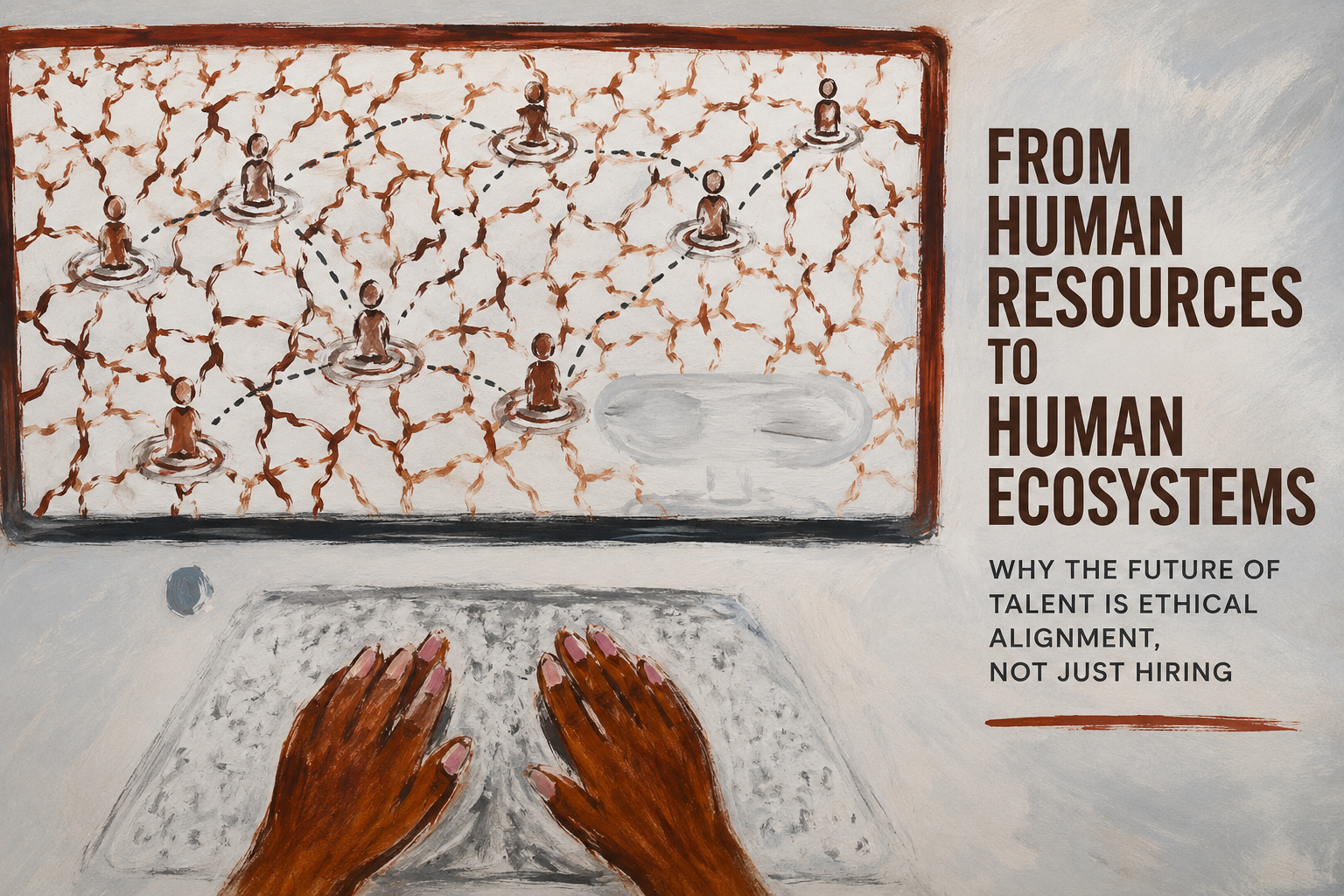

Why the Future of Talent Is Ethical Alignment, Not Just Hiring
For most of modern corporate history, talent has been treated transactionally.
Companies hire.
Companies extract value.
Companies restructure.
Companies lay off.
Companies manage people out.
Companies replace.
But after nearly a decade of watching modern performance management unfold across the tech industry — from layoffs to reorgs, from performance improvement plans to reverse mentoring initiatives — I’ve started to believe something deeper:
We are approaching the limits of treating human beings as resources owned by companies rather than contributors within a broader human ecosystem.
The future of work may depend on whether organizations can evolve from managing labor to stewarding human alignment.
The Hidden Problem Behind Performance Management
Not every underperforming employee is untalented.
Sometimes they are simply misaligned.
A person can be:
- highly intelligent,
- deeply capable,
- operationally excellent,
- and still destructive within a specific organizational culture.
Why?
Because businesses are not just operational systems.
They are value systems.
One company may reward aggressive market domination:
- relentless competition,
- speed over consensus,
- high pressure,
- confrontation,
- and tactical aggression.
Another may prioritize:
- trust,
- long-term relationships,
- ethical transparency,
- sustainability,
- and collaborative growth.
Neither model is universally right or wrong.
But each model creates a different environment for various people to thrive.
The problem begins when someone shaped by one value system is inserted into another.
The “high performer” from Company A may become culturally corrosive in Company B.
Not because they are incapable —
but because their operating philosophy no longer aligns with the ecosystem around them.
And yet today, companies often solve this problem through:
- frustration,
- political isolation,
- quiet exits,
- or formal termination processes.
We call it performance management.
But often it is actually alignment failure.
What If Companies Helped Talent Transition Ethically?
What if organizations stopped viewing departures as disposal?
What if businesses developed trusted relationships with other businesses that operated under different cultural models?
Imagine a world where:
- companies recognize misalignment early,
- transitions happen with dignity,
- and talent is intentionally redirected into environments where they are more likely to thrive.
Not every person belongs in every organization.
But that does not mean they have no value.
In healthy ecosystems, organisms thrive in different environments.
A cactus is not a failed water lily.
The same is true for people.
The Caribbean Tech Talent Pool Is an Early Version of This Future
This realization has changed how I think about the Caribbean Tech Talent Pool.
Initially, the vision was straightforward:
connect Caribbean talent with fair and equitable opportunities in the global technology economy.
But increasingly, I see the pool becoming something larger.
Not just a hiring platform.
Not just a recruiting network.
But an ecosystem layer.
A place where:
- talent remains visible even between organizations,
- businesses can find people aligned with their values and operational styles,
- and professionals can continue moving toward environments where they genuinely belong.
The traditional employment model assumes stability inside a single company.
But the future of work may look more fluid:
- careers spanning multiple ecosystems,
- AI reshaping organizational structures,
- and talent moving dynamically between missions, cultures, and stages of growth.
In that world, talent pools become stabilizers.
Not simply databases of workers —
but infrastructure for human continuity.
Why This Matters in the Age of AI
AI will automate many forms of execution.
But it will not eliminate the importance of human alignment.
In fact, alignment may become more important than ever.
As technical skills become increasingly augmented by AI, organizations will compete less on access to labor and more on:
- trust,
- coherence,
- judgment,
- adaptability,
- and values consistency.
The companies that survive long-term may not be the ones with the most talent.
They may be the ones with the most aligned ecosystems.
A More Human Future of Work
I believe the future of talent management is not ownership.
It is stewardship.
Not:
“How do we keep people?”
But:
“How do we help people contribute meaningfully where they are most aligned?”
Some people will outgrow organizations.
Some organizations will outgrow people.
Some value systems will simply conflict.
That is not failure.
That is human complexity.
And perhaps the next evolution of leadership is not merely building successful companies —
but participating responsibly in the larger ecosystem of human potential.
The Caribbean deserves to be part of shaping that future.
And I believe we already are.
The Reality Business Owners Face
I also want to acknowledge something important as a business owner myself:
Most companies are not intentionally trying to mishandle people.
The reality is that leadership is already carrying enormous operational pressure.
When a values mismatch happens inside an organization, most leaders are not thinking:
“How do we ethically transition this person into a more aligned ecosystem?”
They are thinking:
- How do we protect the team?
- How do we maintain delivery?
- How do we reduce disruption?
- How do we preserve runway?
- How do we avoid hurting the business?
- How do we move quickly?
Because the truth is:
ethical talent stewardship is operationally expensive.
It takes time to:
- understand a person deeply,
- assess cultural compatibility,
- identify aligned organizations,
- build trusted relationships between companies,
- and create safe transitions that do not destabilize someone’s livelihood.
Most businesses simply are not structured for that.
And I understand why.
No CEO wants to:
- carry prolonged uncertainty,
- create additional overhead,
- pause execution to coordinate human transitions,
- or risk operational slowdown while trying to “do the right thing.”
Especially in difficult economic environments.
The market rewards speed.
Not reflection.
And yet, I still believe this conversation matters.
Not because I already have the perfect solution —
but because I think we are approaching a future where the old model becomes increasingly unsustainable.
As AI reshapes labor markets and organizational structures become more fluid, companies may eventually need shared ecosystems that support talent movement more ethically and intelligently.
That transition infrastructure does not fully exist yet.
But perhaps talent pools, trusted networks, and inter-company relationships are early signs of what it could become.
The Caribbean Tech Talent Pool is part of how I’m exploring that possibility.
Not as a perfect answer.
But as an attempt to move in a more human direction.
- Join the pool.
2. Give me tips how businesses can bridge the gap and be better, lets implement it!